
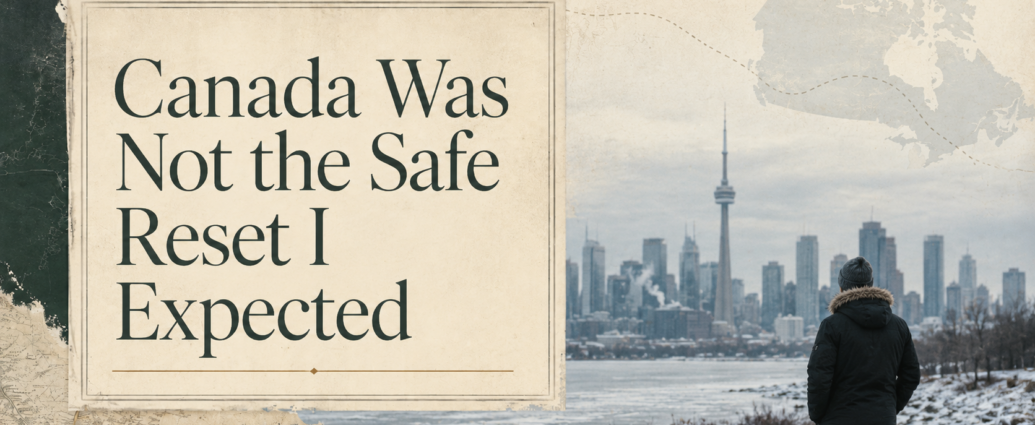
Canada surprised me.
Not because it was foreign. In many ways, Canada felt familiar enough. It shares a long border with the United States, a language, a lot of media, a lot of assumptions, and a similar idea of middle-class life. From the outside Canada often presents itself as the calmer cousin: polite, stable, reasonable, safer, less chaotic.
That was part of the appeal.
After America and Germany, I wanted a reset. I wanted a country where my family could breathe. I wanted familiar systems without the same level of American intensity. I wanted a place that still felt Western, orderly, and sane. Also, there was a lot of outdoors to be explored.
Canada seemed like it might be that place.
And to be fair Canada has real strengths. There are beautiful landscapes, kind people, good schools in many areas, and a civic politeness that can feel refreshing.
But reputation can lag behind reality.
The Canada I encountered was not the postcard version. It had many of the same problems I thought we were leaving behind: visible homelessness, addiction, unaffordable housing, strained services, and a political culture that often seemed more comfortable managing language than solving problems.
Housing was one of the clearest signs. If families cannot afford space, stability begins to crack. It affects birth rates, marriage, neighbourhoods, mental health, and the ability to plan.
Then there was addiction. When addiction becomes highly visible in public spaces, it changes how families experience a city. You begin mapping routes. You avoid certain corners. You explain things to your children earlier than you wanted to. You don’t walk by the safe injection sites unless you absolutely have to. My kids saw many dead bodies laying ont he sidewalk in Ottawa.
Canada forced me to accept that leaving America had not solved the deeper problem. The issues I was worried about were not confined to one country. They were spreading across the Western world in different accents and under different flags: public disorder, housing pressure, institutional weakness, managed speech, and governments asking families to trust systems that visibly were not working. A familiar way of life was quickly disappearing.
Canada was supposed to be the safe reset. Instead, it became another chapter in the same lesson: a country’s reputation is not enough. A family has to live in reality.